Tiwesdaeg, een Anglo-Saxische naam voor Tuesday
- In de Germaanse godsdienst gold Tyr (Tiw/Tiu; bij ons Dingsus) als de worstelaar van de goden.
- De Romeinse naam voor deze dag was dies Martis, &#n34;dag van Mars&#n34;, hun oorlogsgod.
- In de Germaanse mythologie is hij de zoon van Odin en Frigga en is hij de dapperste van alle goden.
- The ancient southern Germans gave him the name Ziu while the northern Germans called him Tiuz.
- The Scandinavians called him Tyr and the Anglo-Saxons Tiw.
- It is generally believed that all of the Germanic names correspond to the Sanskrit dyaus, het Griekse Zeus en het Latijnse Deus.
- If these etymological sources are accurate, then the Germanic names for the god must come from a common Indo-European name which began by simply signifying &#n34;divinity&#n34;.
- Later his name meant &#n34;sky god&#n34;.
- In modern German, his name means &#n34;thing&#n34; from which the German Tuesday, Dienstag, is derived.
- It is probably Tiw who is referred to in a Latin inscription on a Roman altar discovered at Housesteads in Northumberland, near Hadrian's Wall.
- This altar dates from the third century and was erected by German soldiers serving with the Roman legions.
- It bears this Latin inscription: Deo Marti Thincso et duabus Alaisiagis Bede et Fimmiline et numini Augusti Germani cives Tuihanti v. s. l. m. (votum solverunt libenter merito) or &#n34;To the god Mars Thincsus and to the two goddesses Alaisiages Beda and Fimmilina and to the majesty of the divine Augustus, the German citizens of Twenthe address this merited homage.&#n34; (The province of Twenthe was north of the Rhine on the present frontiers of Holland and Germany).
- The epithet Thincsus shows that Tiw was considered in the same category as Mars who presided over the &#n34;thing&#n34;, the term used for the assembly where discussions of the community were regulated according to law.
- Tiw's &#n34;spear&#n34; is less a weapon than a sign of judicial power and authority.
- Tyr, another name for Tiw, is supposed to have been extremely brave and it was often he who awarded victory to one of the sides engaged in battle; it was thought to be a wise idea to pray to him when going into combat.
- Tyr and Woden formed a pair which is found elsewhere among the Indo-European people: the one-handed and the one-eyed, the man of law and the man of magical &#n34;fury&#n34;.
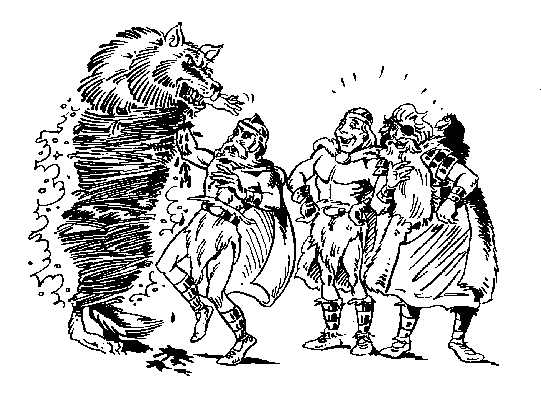
Tiw was known to have lost his right hand to Fenrir the wolf, but that's a story for the future.
Hierop drukken brengt u de kalenderelementen met aanvullende informatie over kalenders.